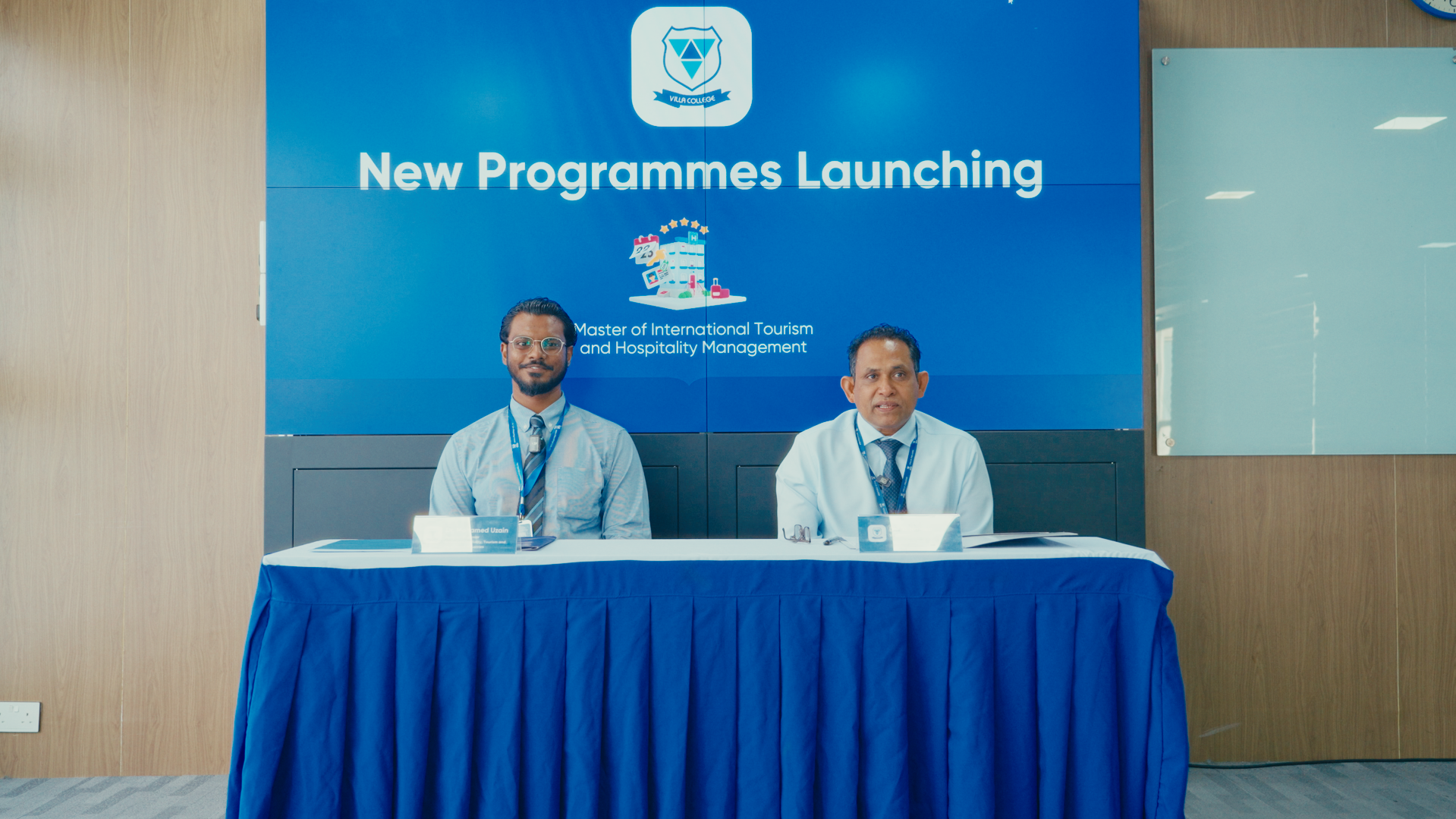
The expansion of global and regional tourism demands sophisticated leadership, strategic foresight, and specialized operational expertise, particularly within rapidly developing destination markets across the Maldives and the wider Asia-Pacific region. To address this evolving industry demand, Villa College’s School of Hospitality, Tourism and Experiential Industries introduced the Master of International Tourism and Hospitality Management on 21 July 2026. Designed to bridge advanced academic theory with practical industry execution, the postgraduate programme prepares professionals to assume senior executive roles across the sector. Because tourism serves as the fundamental economic pillar of the Maldives, cultivating highly capable managers is both a vital national interest and an institutional responsibility. By delivering a qualification aligned with international standards directly within the country, Villa College enables mid-career practitioners and emerging leaders to elevate their strategic competencies without relocating abroad or interrupting their professional careers.
A critical feature of the programme is its flexible delivery model, which combines e-learning platforms with face-to-face instruction. For working professionals, balancing higher education with ongoing workplace responsibilities presents a traditional dilemma. Whereas full-time residential study often requires candidates to take an extended career break, resulting in lost income and operational disruption for employers, the blended delivery structure at Villa College allows academic study to sit alongside full-time employment. Mid-career professionals maintain workplace continuity while acquiring advanced strategic management skills. Vice Rector Dr. Ali Najeeb highlighted this operational advantage, noting that building capable professionals equipped with strategic thinking is a responsibility Villa College takes on. He emphasized that the programme offers industry practitioners the opportunity to obtain an education of international standard while remaining in the Maldives.
The postgraduate curriculum is structured systematically across three semesters to foster strategic leadership, analytical rigor, and operational capability. The first semester establishes core management concepts through four compulsory fifteen-credit modules: Creativity, Innovation and Entrepreneurship; Customer Experience Management; Sustainability and Resilience in Tourism Operations; and Strategy and Leadership. Moving into the second semester, the focus shifts toward quantitative and methodological mastery through three compulsory modules: Digital Transformation and Hospitality Data Analytics; Hospitality Financial Planning and Simulation; and Business Research Methods. Alongside these core analytical modules, students select one elective from Project Management, Global Marketing and Brand Strategy, Hospitality Law and Policy, or Cultural Tourism. The final semester culminates in a thirty-credit capstone module, representing the largest single assessment component of the award. Students choose one capstone pathway tailored to their strategic goals: an Action Research Paper in Tourism and Hospitality, an Executive Project in Tourism and Hospitality, or a Case Study Research Paper.
The analytical depth of the curriculum reflects a shift away from traditional, intuitive decision-making toward evidence-based management. Rather than relying on subjective assumptions, graduates learn to evaluate the relevance and validity of qualitative and quantitative data, applying robust analytical techniques to complex operational scenarios. Assistant Professor Dr. Mohamed Uzain of the School of Hospitality, Tourism and Experiential Industries explained that the programme is designed to help graduates keep pace with a rapidly changing business environment, joining theory to practical experience with specific attention to digital transformation, data analytics, and sustainability. Because the natural environment is the central asset of destination tourism, sustainability and resilience planning are embedded directly into the initial semester and integrated throughout the learning outcomes. Graduates emerge equipped to apply digital tools, conduct financial simulations, and construct sustainable operational strategies that enhance customer experience and preserve environmental resources.
To ensure accessibility for experienced industry practitioners, Villa College provides two distinct entry pathways for the September 2026 intake. General admission requires a related bachelor's degree or a related Level 8 graduate diploma. Alternatively, an entry pathway recognizes substantial professional experience for candidates aged 25 or older. Candidates holding a related Level 5 qualification with seven years of relevant experience, including three and a half years gained post-qualification, or a related Level 6 qualification with six years of relevant experience, including three years post-qualification, are eligible following the completion of a pre-Masters programme approved by the Maldives Qualifications Authority. For prospective candidates and sponsoring organizations, maximizing the value of the programme involves early strategic planning, such as aligning elective choices and capstone projects with organizational priorities. Applications for the September 2026 intake are currently open and can be submitted online through the Villa College website at www.villacollege.edu.mv.