Villa College promotes inclusive governance and public participation by providing platforms for dialogue on national and international issues. Through consultations, policy forums, conferences and stakeholder engagements in 2025, the College facilitated the exchange of perspectives on public policy, democratic participation, sustainability and other key societal issues, fostering informed discussion and institutional collaboration.
Villa College supports inclusive governance, constructive political dialogue and public participation by providing an academic environment for discussing issues affecting the Maldives and the wider international community. Through its faculties, research centres and collaborations with government institutions, international organisations, civil society and professional bodies, the College facilitates dialogue on democratic participation, public policy, economic governance, digital transformation, environmental sustainability, human rights and access to justice.
During 2025, Villa College hosted and supported parliamentary consultations, policy forums, conferences and panel discussions involving political representatives, government officials, academics, industry professionals and community stakeholders. These initiatives provided opportunities to exchange perspectives on national challenges, contributing to informed discussion and institutional cooperation.
Parliamentary Dialogue on Online Violence Against Women in Politics
On 18 March 2025, Villa College facilitated a validation session for the Parliamentary Inquiry on Online Violence Against Women in Politics, undertaken in collaboration with the Human Rights and Gender Committee of the People's Majlis and the Westminster Foundation for Democracy (WFD). Held at Meeruma Hotel, Malé, the session brought together representatives of different political parties, including the women's wings of the Maldivian Democratic Party (MDP), Maldives National Party (MNP), People's National Congress (PNC) and other parties, alongside representatives from the People's Majlis, Attorney General's Office, UNDP, Transparency Maldives, British High Commission, media and civil society.
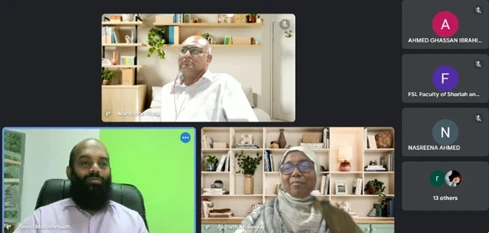
Led by Amish Abdullah of the Faculty of Shariah and Law, Dr. Fazeela Ibrahim of the Institute for Research and Innovation and Janet Veitch of WFD, the session examined research findings concerning online harassment, gender-based intimidation and barriers to women's political participation. Participants contributed perspectives on research methodology, institutional responses and potential legal safeguards. By facilitating discussion among stakeholders from different political affiliations, Villa College provided a platform for cross-party engagement on a shared democratic challenge, supporting inclusive political participation and evidence-informed consideration of institutional reforms.
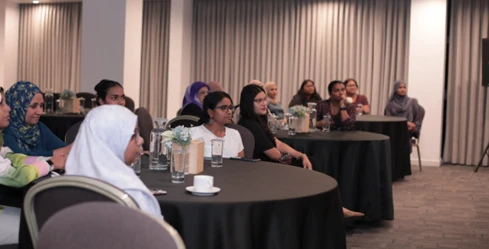
International Policy Dialogue on Clean Energy and Climate Change Mitigation
On 24 and 25 February 2025, Villa College hosted Conversations on Clean Energy and Climate Change Mitigation, organised in partnership with the United Kingdom Government and United Nations Development Programme (UNDP). Held at the College's QI Campus, the two-day programme brought together government ministers, international representatives, policymakers, environmental specialists, industry professionals, civil society organisations and academics to discuss renewable energy, climate finance and sustainable development. Participants included Mohammad Saeed, Minister of Economic Development and Trade; Thoriq Ibrahim, Minister of Climate Change, Environment and Energy; Nick Low, British High Commissioner to the Maldives; and Enrico Gaveglia, UNDP Resident Representative. Discussions examined renewable energy policies, infrastructure development, financing challenges and the responsibilities of government, businesses and communities in advancing climate action.
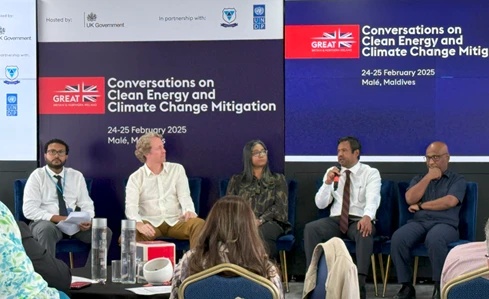
The programme also included a panel on renewable energy transition involving Villa College's Deputy Vice Rector, Abdul Munnim Mohamed Manik, and a complementary discussion titled From Knowledge to Social Impact, moderated by Dr. Fazeela Ibrahim, which explored how academic research could inform responses to environmental and social challenges. Together, the sessions enabled dialogue between national policymakers, international partners and academic specialists on issues central to the Maldives' climate and economic development priorities.
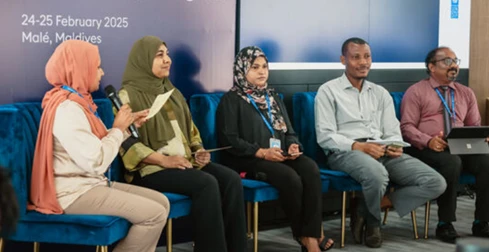
Entrepreneurship Policy Forum: Government, Industry and Academic Dialogue
On 19 November 2025, Villa College's Centre for Innovation and Entrepreneurship Development, in collaboration with the Ministry of Economic Development and Trade (MOEDT), organised the MOEDT Policy Forum during Global Entrepreneurship Week Maldives 2025. Held at the College's Ocean View Hall, the forum brought together government officials, entrepreneurs, industry representatives and academics to discuss economic diversification, business regulation and entrepreneurial development. The programme featured Hussain Zamir, Minister of State for Economic Development and Trade, alongside ministry officials and representatives from financial and business institutions.
Discussions and presentations addressed business registration, regulatory requirements, financial literacy, digital technologies and e-commerce opportunities.
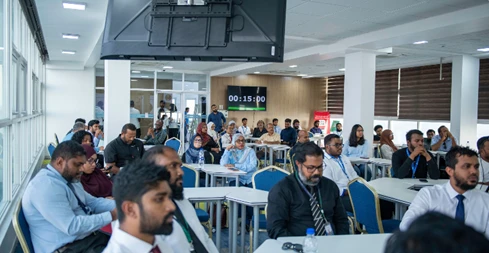
By bringing public authorities and business stakeholders into an academic setting, Villa College facilitated engagement on practical regulatory challenges and opportunities for strengthening the entrepreneurial environment in the Maldives.
Decentralisation by Design: Local Knowledge and National Policy
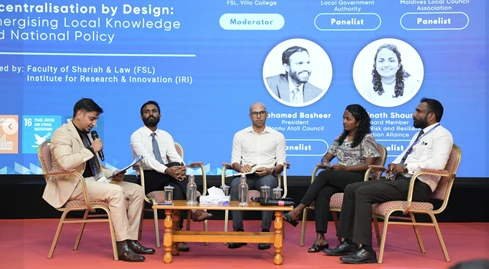
On 11 September 2025, Villa College's Faculty of Shariah and Law and Institute for Research and Innovation organised the panel discussion Decentralisation by Design: Synergising Local Knowledge and National Policy as part of the 9th International Conference on Social Research and Innovation (ICSRI 2025). The panel examined the relationship between local governance, community knowledge, public participation and national policymaking, with particular emphasis on incorporating local perspectives into institutional decisions. These issues are especially significant in the Maldives, where geographical dispersion creates distinct challenges for local administration, public service delivery and democratic participation. Through this discussion, Villa College provided an academic platform for considering decentralisation, institutional accountability and more inclusive approaches to national and local governance, encouraging the exchange of perspectives on the relationship between community needs and public-policy decisions.
Digital Higher Education Governance: Multi-Stakeholder Discussion
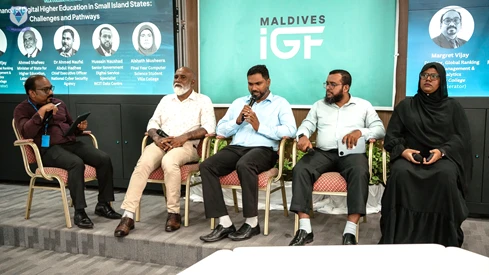
During October 2025, Villa College facilitated a panel titled Governance of Digital Higher Education in Small Island States, held in connection with the Maldives Internet Governance Forum 2025. Moderated by Dr. Margret Vijay of Villa College, the panel included Ahmed Shafeeu, Minister of State for Higher Education, Labour and Skills Development; Dr. Ahmed Naufal Abdul Hadhee, Chief Executive Officer of the National Cyber Security Agency; Hussain Naushad, Senior Government Digital Service Specialist at the NCIT Data Centre; and Aishath Musheera, a Villa College Computer Science student.
The discussion addressed digital transformation, cybersecurity, infrastructure, accessibility and education-policy challenges in Small Island Developing States. By bringing together government representatives, technical specialists, academic administrators and a student representative, the panel enabled different institutional and user perspectives to be considered in discussions on the governance of digital higher education.
Telecommunications and Digital Infrastructure: Public and Industry Perspectives
On 24 October 2025, Villa College hosted The Future of Networks and Telecommunications in the Maldives, another panel associated with the Maldives Internet Governance Forum 2025. Moderated by Aminath Shiufa, Secretary General of Women in Tech Maldives, the discussion featured representatives from the Maldives Information Communication Technology Alliance, Fenaka Corporation Ltd. and ROL. Participants examined telecommunications development, connectivity, network security and emerging infrastructure challenges, exchanging perspectives from public-sector-linked services, professional associations and private telecommunications operations. The session contributed to wider discussion on digital infrastructure and the development of reliable, accessible communication services in the Maldives.
Legal, Environmental and Human Rights Dialogue Facilitated by the Faculty of Shariah and Law
Through the Faculty of Shariah and Law (FSL) and its Centre for Transformative Environmental and Marine Law (CTEM), Villa College also supported national and international discussions on human rights, environmental accountability, climate governance, international law and access to justice. Although primarily academic and professional in nature, these initiatives provided additional settings for exchanging perspectives on legal and public-policy challenges.
World Water Day Roundtable on Water and Environmental Governance
On 28 March 2025, CTEM organised a roundtable discussion commemorating World Water Day, examining water-related challenges and environmental governance. The activity provided a forum for discussing sustainable resource management and the importance of legal and institutional responses to water security, particularly in island communities.
International Conference on Climate Justice and Sustainable Environment
From 25 to 27 July 2025, Villa College participated as an institutional partner in the International Conference on Climate Justice and Sustainable Environment, organised in association with Gujarat National Law University and Gujarat Maritime University in Gandhinagar, India. The conference brought together international academics, researchers and legal professionals to discuss environmental accountability, climate justice and sustainability. Through its participation, Villa College contributed to international academic dialogue on legal and institutional responses to environmental challenges relevant to Small Island Developing States.
Climate Change and International Courts: Webinar Dialogue on Advisory Opinions
On 12, 16, and 22 October 2025, CTEM, with the University of the West Indies and international partners, hosted a webinar series on international courts' climate advisory opinions. Discussions focused on state responsibilities, environmental accountability, climate justice, and impacts on vulnerable states, enabling scholars and experts to exchange insights on international climate law.
International Conference on Civilizations and Human Rights
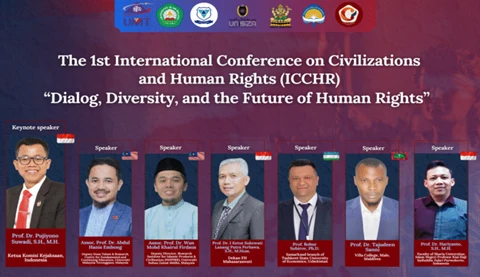
On 14–15 November 2025, Villa College co-hosted the International Conference on Civilizations and Human Rights in Denpasar, Indonesia, themed Dialog, Diversity, and the Future of Human Rights. Partnering with Indonesian and Malaysian institutions, the event convened global scholars and legal experts to examine human rights, diversity, social justice, governance, and institutional responsibilities. Villa College's participation advanced cross-border dialogue on fundamental rights and the intersection of law, society, and public institutions.
International Climate Change Law Conference: Environmental Rule of Law and Accountability
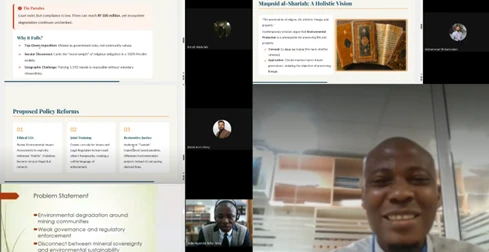
On 10 December 2025, Villa College's Faculty of Shariah and Law, through CTEM, organised the International Climate Change Law Conference, under the theme Climate Change in the Age of Change and the Transformative Environmental Rule of Law: Where Are We and Where Are We Going? Organised with international academic and environmental partners, the conference featured Professor Henk Addink of Utrecht University, addressing the precautionary principle, and Professor Andi Arsana of Gadjah Mada University, discussing sea-level rise and maritime sovereignty.
Mohammenul Islam of UNODC contributed perspectives on fisheries crime and environmental governance. A central panel examined the recognition of ecocide and its prospects in the Maldives. Moderated by Abdulkareem Azeez and Dr. Mohammad Shekaib Alam, with contributions from Dr. Nfor Nfor Nyambi, Mohd Arsh Shery and Dr. Tajudeen Sanni, the discussion considered legal definitions, institutional accountability and the possible development of environmental criminal-law protections. The conference provided a setting for international legal dialogue on climate justice, environmental responsibility and regulatory approaches relevant to the Maldives.
Postgraduate Research Dialogue on the Law of the Sea and Maritime Governance
In December 2025, CTEM's recorded international postgraduate engagement included the DEHUKAM Post-Graduate Research Conference on the Sea and Maritime Law – II, conducted virtually on 15 December 2025. The conference provided an academic platform for examining ocean governance, maritime law, environmental protection, maritime security and international dispute settlement. The FSL Annual Report identifies collaboration with DEHUKAM, although the precise organisational role of CTEM remains subject to departmental confirmation.
Maldives ADR Week 2025: Dialogue on Justice and Institutional Development
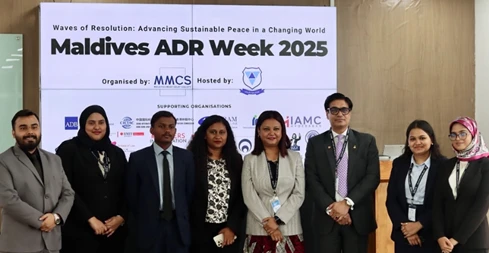
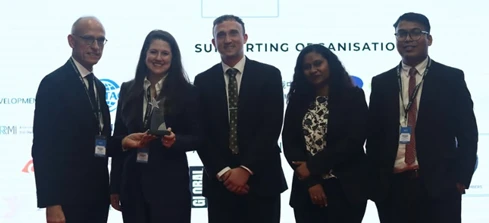
From 26 to 30 October 2025, Villa College's Faculty of Shariah and Law hosted Maldives ADR Week 2025, organised by the Maldives Moot Court Society (MMCS) under the theme Waves of Resolution: Advancing Sustainable Peace in a Changing World. The programme brought together domestic and international legal professionals, academics and students to discuss developments in alternative dispute resolution and the administration of justice.
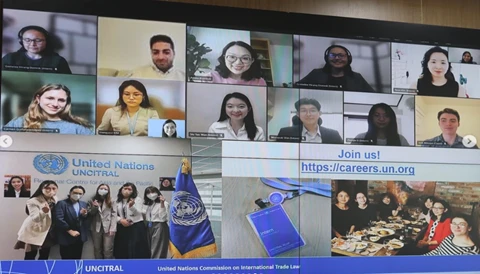
The programme also included UNCITRAL Asia Pacific Day, co-organised with the United Nations Commission on International Trade Law Regional Centre for Asia and the Pacific (UNCITRAL-RCAP), addressing electronic commerce, digital trade frameworks, artificial intelligence and automated contracting. Collectively, these discussions encouraged professional exchange on access to justice, effective institutions, environmental disputes and peaceful conflict resolution.
International Economic Policy and Geopolitical Dialogue at the 31st IIOA Conference
From 6 to 11 July 2025, Villa College hosted the 31st International Input-Output Association Conference, bringing together economists, policymakers, government officials and international researchers to discuss trade, geopolitical developments, economic resilience and sustainable development. The main proceedings commenced on 8 July 2025, with Ahmed Munawar, Governor of the Maldives Monetary Authority, delivering the chief guest address. Discussions addressed global supply chains, climate policy, digital economies and the economic implications of changing international relationships. The conference provided opportunities for engagement between academic researchers, government institutions and economic-policy specialists.
Shariah and Sustainability: Dialogue on Environmental Stewardship
On 20 March 2025, Villa College's Faculty of Shariah and Law organised a panel discussion on Shariah and Sustainability: Islamic Principles for Environmental Stewardship. The session examined the relationship between Islamic ethical principles and contemporary environmental responsibilities, including sustainable resource management, climate action and conservation. It encouraged interdisciplinary discussion on the relevance of legal and ethical frameworks to environmental governance.
The panel highlighted fundamental Islamic environmental concepts such as Khilafah (stewardship and guardianship of the Earth), Mizan (ecological balance and harmony), and Amanah (sacred trust), exploring how these traditional values directly align with international sustainability frameworks and national environmental policy goals. Scholars, legal practitioners, and faculty members engaged in detailed exchanges on the practical application of Shariah principles in combating climate change vulnerabilities—a priority of critical relevance to Small Island Developing States like the Maldives.
International Women's Day: Dialogue on Gender Equality and Leadership
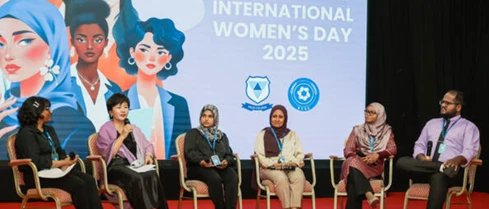
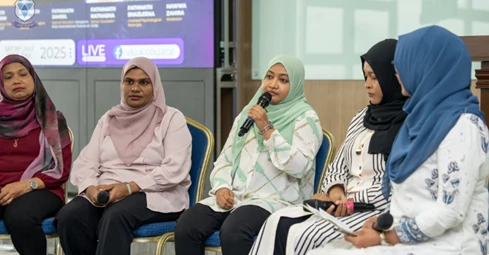
During March 2025, Villa College commemorated International Women's Day through an institutional programme on gender equality and women's leadership. The event featured a keynote by Aisha Nurain Janah, Founder of Kandūfā Foundation, and a panel titled Opportunities and Roadblocks Faced by Women. Participants examined professional opportunities, leadership barriers and societal challenges affecting women, contributing to wider discussion on gender equality and institutional inclusion.
Parenting Symposium: Dialogue on Family and Community Wellbeing
On 19 July 2025, Villa College, in partnership with UNICEF Maldives, organised the Parenting Symposium 2025. The programme brought together parents, caregivers, educators and specialists to discuss child development, parenting challenges, behavioural support and family wellbeing. Through moderated discussions and workshops, the symposium encouraged the exchange of professional knowledge and community perspectives on issues affecting children and families.
Wider Public-Policy Dialogue at ICSRI 2025
On 10 and 11 September 2025, Villa College organised the 9th International Conference on Social Research and Innovation (ICSRI 2025), under the theme Synergies of Discovery: Igniting Solutions for the Future. The conference brought together researchers, academics, professionals and government representatives to discuss governance, migration, social inclusion, technology, environmental sustainability and institutional development. Its interdisciplinary sessions provided a platform for sharing research perspectives on public-policy challenges, complementing the specific Decentralisation by Design panel described above.
Through these cross-sectoral policy forums, international legal conferences, and multi-stakeholder symposia, Villa College establishes itself as an essential neutral platform for constructive dialogue, inclusive governance, and public participation across the Maldives. By convening key political parties, executive authorities, international organizations, civil society groups, and legal scholars, the College bridges the divide between academic discourse and actionable public policy on vital issues such as political inclusion, climate justice, digital transformation, and access to justice. Ultimately, these collaborative discussions cultivate cross-party engagement, elevate evidence-informed decision-making, and reinforce the institution's ongoing commitment to fostering democratic accountability and sustainable national development.