Parliamentary Inquiry on Online Violence Against Women in Politics
Policy Impact: Provided the research base for a parliamentary inquiry, informing legislative and institutional responses to online violence against women in political life.
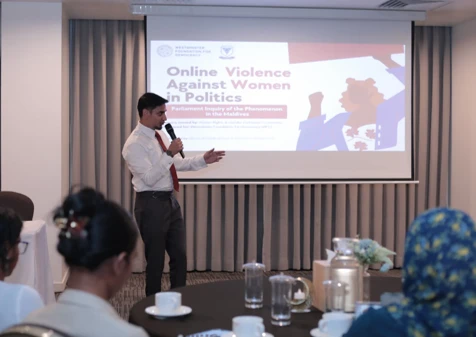
On 18 March 2025, Villa College held a validation session at Meeruma Hotel, Malé, for its research collaboration under the Parliamentary Inquiry on Online Violence Against Women in Politics. The College was research lead for the initiative, which was carried out with the Human Rights and Gender Committee and the Westminster Foundation for Democracy (WFD). The session presented the research to stakeholders for validation, so that the evidence going to the inquiry reflected the experiences of women in Maldivian political spaces.
Through this work, Villa College was directly involved in identifying problems and challenges (the forms and effects of online abuse faced by women in politics) and in developing evidence-based responses for parliamentary consideration. The engagement contributes to SDG 5 (Gender Equality), particularly women’s full and effective participation in political life, SDG 16 (Peace, Justice and Strong Institutions) and SDG 17 (Partnerships for the Goals).
Maafushi Island Strategic Plan: Community Consultation
Policy Impact: Facilitated community-driven priority setting for a five-year local development plan.
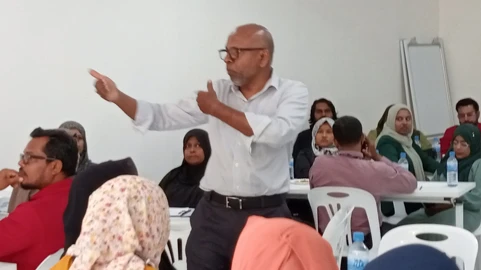
In June 2025, the Maafushi Island Council invited Villa College to facilitate a community consultation as part of developing the island’s Strategic Plan. The session, led by QISB Senior Lecturers Ahmed Fayaz and Mohamed Ali Sharfuddin and Deputy Dean Dr. Damith Gangodawilage, brought local stakeholders together to identify and discuss priorities for the next five years, so that the community’s voice would directly shape the island’s development direction.
By applying strategic planning methods to local governance, the College helped the council identify challenges and set priorities. This supports SDG 11 (Sustainable Cities and Communities) and SDG 16 (inclusive, participatory decision-making), and shows SDG 17 partnership between academia and local government.
National Research Grant Management Partner
Policy Impact: Strengthened the national system for evidence-based decision-making by managing the first national research grant.
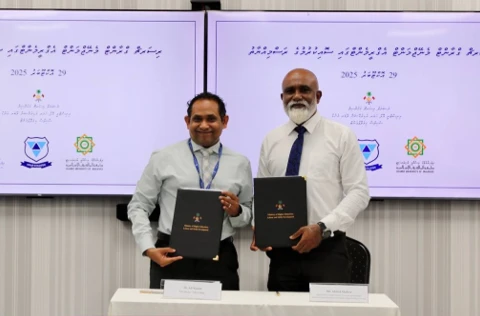
In October 2025, Villa College signed an agreement with the Ministry of Higher Education, Labour and Skills Development and was recognised as one of the National Research Grant Management Partners. Under this partnership, the College manages and administers a national research grant that supports academics and scholars in research contributing to national growth and development. It is the first time a national research grant has been formally introduced in the Maldives.
The appointment puts Villa College at the centre of a national system for producing research for decision-making on matters of national importance. It directly supports SDG 17 (strengthening domestic capacity for data, monitoring and evidence) and SDG 9 (enhancing scientific research).
MOEDT Policy Forum – Global Entrepreneurship Week Maldives 2025
Policy Impact: Connected government, finance and entrepreneurs on the policy and regulatory environment for start-ups and SMEs.
As national host of Global Entrepreneurship Week (GEW) Maldives 2025, Villa College’s Centre for Innovation and Entrepreneurship Development hosted the MOEDT Policy Forum on 19 November 2025. State Minister Hussain Zamir opened the forum by setting out the Ministry’s commitment to an enabling policy environment for start-ups, SMEs and emerging sectors. Ministry officials then briefed participants on legislative frameworks, regulatory requirements and business registration. Maldives Islamic Bank delivered a financial literacy session, and Maldives Post Office introduced its E-Tukuri e-commerce service for small businesses.
The forum created a direct channel between policymakers and the entrepreneurs affected by their policies, so that implementation challenges could be raised and addressed. It contributes to SDG 8 (Decent Work and Economic Growth), SDG 9 and SDG 17.
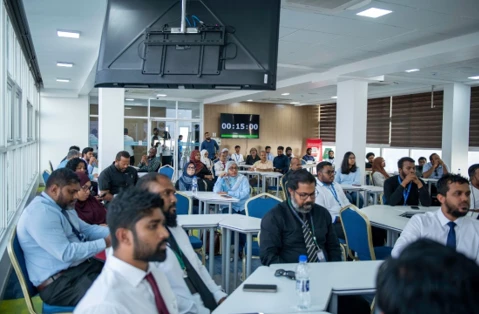
Governance of Digital Higher Education in Small Island States – Maldives IGF 2025
Policy Impact: Brought government, cyber-security and student voices together on policy for accessible, secure digital higher education.
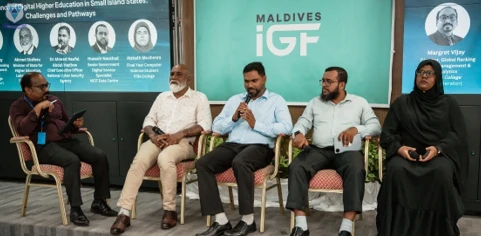
As part of the Maldives Internet Governance Forum 2025, Villa College hosted a panel on the Governance of Digital Higher Education in Small Island States, moderated by Dr. Margret Vijay, Director of Global Ranking Data Management & Analytics and the Centre for Open and Distance Learning. Panellists were Ahmed Shafeeu, Minister of State for Higher Education, Labour and Skills Development; Dr. Ahmed Naufal Abdul Hadhee, Chief Executive Officer of the National Cyber Security Agency; Hussain Naushad of the NCIT Data Centre; and a final-year Villa College Computer Science student. The discussion covered accessibility, cyber-security, policy development and student experience. It provided input to the governance of digital learning in the Maldives (SDG 4, SDG 9, SDG 16 and SDG 17).
Student Research to Parliament: LLM Research Colloquium 2025
Policy Impact: Created a pathway for postgraduate legal research to inform national legislation.
The Faculty of Shariah and Law hosted the LLM Research Colloquium 2025 on Global Business and Finance Law, where postgraduate students and legal experts examined how Maldivian law intersects with the evolving global legal order. A key outcome is that students will present their research directly to the Parliament of the Maldives, turning academic work into policy considerations for lawmakers (SDG 16 and SDG 17).
Implementing National Education and Skills Policy
Policy Impact: Delivered government-funded programmes that put national inclusive education and skills policies into practice.
In August 2025, the College signed an MoU with the Ministry of Education to launch the Diploma in Teaching Primary and Special Educational Needs under the government’s national teacher training initiative. The one-year programme is free for trainees and includes a monthly stipend, building the specialist teachers needed for inclusive classrooms (SDG 4 and SDG 10). Under the Ministry of Higher Education’s Sustainable and Integrated Labour Services (SAILS) project, the College also signed training contracts and offered fully funded National Certificate 3 training in Guesthouse Operations for unemployed people (SDG 8).

Research Training for People’s Majlis Staff and Committee Research Officers
Policy Impact: Strengthened Parliament’s in-house capacity to produce evidence for law-making and parliamentary inquiries.
The Faculty of Shariah and Law delivered a full-day Research Training Workshop for staff and Committee Research Officers of the People’s Majlis in December 2025. Academic researchers Dr. Tajudeen Sanni, Mr. Amish Abdullah, Dr. Shekaib Alam, Mr. Mohd Arsh Shery and Dr. Nfor Nyambi covered how to structure policy-oriented research, how targeted desk reviews for tabled policy research and inquiries differ from academic literature reviews, empirical research in legal contexts, and applying data-driven findings to drafting and reviewing laws (Trainees then solved real policy scenarios in timed group exercises. The workshop supports more transparent, evidence-based law-making (SDG 16 and SDG 17).
Under the College’s MoU with the People’s Majlis, students from Villa College and Villa International High School also took part in a parliamentary education visit (photos). They observed live sittings and met Secretariat officials to learn how laws are made and how Parliament oversees government.
Joint Research Partnership with the Maldives Monetary Authority
Policy Impact: Created a formal channel for joint research supporting evidence-based financial and economic policy.
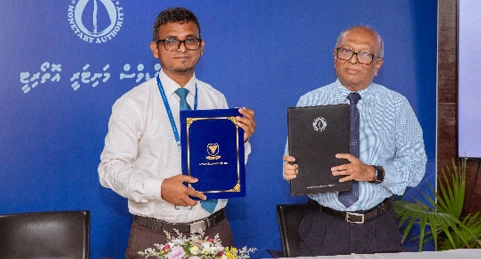
In July 2025, Villa College signed an MoU with the Maldives Monetary Authority (MMA), the country’s central bank and financial regulator. Under the agreement, the two institutions will strengthen joint research and capacity-building initiatives (announcement). This gives the College a direct route for supplying evidence and analysis to the institution responsible for monetary policy and financial stability (SDG 8, SDG 16 and SDG 17). The partnership builds on MMA’s involvement in the College’s research events in 2025: MMA Governor Ahmed Munawar was Chief Guest at the 31st IIOA Conference, and MMA endorsed ICSRI 2025.
SAASTHURA: National Nursing Research Platform
Policy Impact: Helped identify national nursing and healthcare challenges and evidence-based solutions with Ministry of Health leadership.
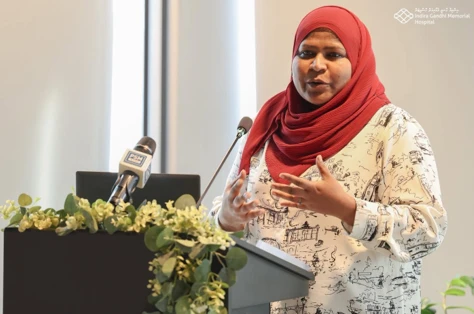
In May 2025, the MCGH Nursing Steering Committee launched SAASTHURA, the first dedicated national nursing research dissemination platform. Villa College lecturers sat on the judging panel for presentations by nurses from DH/IGMH, Hulhumalé Hospital and Kulhudhuffushi Regional Hospital. A policy panel at the launch, with the Ministry of Health’s Quality Commissioner, the Director General of Nursing at DH/IGMH and the Head of the Infection Prevention and Control Unit, discussed key challenges in nursing and healthcare and possible solutions. Through this role, the College contributes to evidence-based standards for national nursing practice (SDG 3 and SDG 17).
Public Health Policy Dialogue with WHO Maldives (UN80)
Policy Impact: Reviewed national public health policy and set priorities for the shift from infectious diseases to NCDs and mental health.
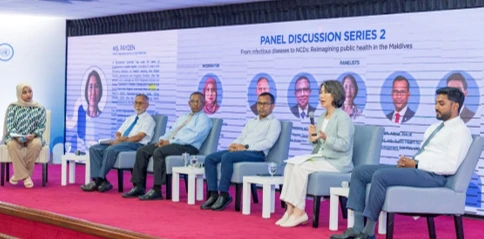
On 19 October 2025, Villa College and WHO Maldives presented the second panel discussion in the series commemorating 60 years of the Maldives at the United Nations and 80 years of the UN, co-hosted by the Ministry of Foreign Affairs and the United Nations in the Maldives. Under the theme “From Infectious Diseases to NCDs – Reimagining Public Health in the Maldives”, the panel brought together Mr. Mohamed Ismail Fulhu, Mr. Hassan Mohamed of the Health Protection Agency, Dr. Abdul Malik of the NCD Alliance, Ms. Payden (WHO Representative to the Maldives) and Villa College youth representative Mr. Hussain Junaan (UN Maldives report).
Panellists reviewed how national policy frameworks, including the National Mental Health Policy and healthcare quality standards developed with WHO technical assistance, have shaped health outcomes. They also identified youth engagement, technology and community action as priorities for reducing the burden of non-communicable diseases (SDG 3 and SDG 17).
Centre for Transformative Environmental and Marine Law
Policy Impact: Established the Maldives’ first dedicated hub for research, advocacy and policy work on environmental and marine law.
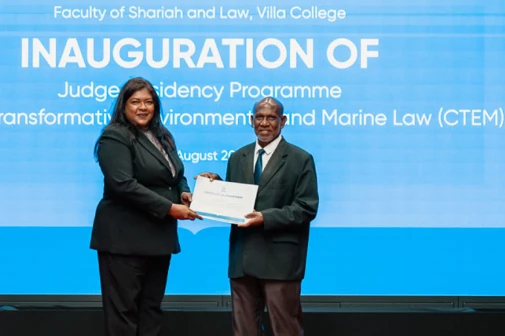
The Minister of State for Fisheries and Ocean Resources, Dr. Amzath Ahmed, officially launched the Centre for Transformative Environmental and Marine Law (CTEM), the first centre of its kind in the Maldives. CTEM is a hub for the research, advocacy and policy work needed for environmental justice. In 2025 it published a peer-reviewed ocean monograph and convened an International Climate Change Law Conference, linking national policy discussion with international legal scholarship (SDG 13, SDG 14 and SDG 16).