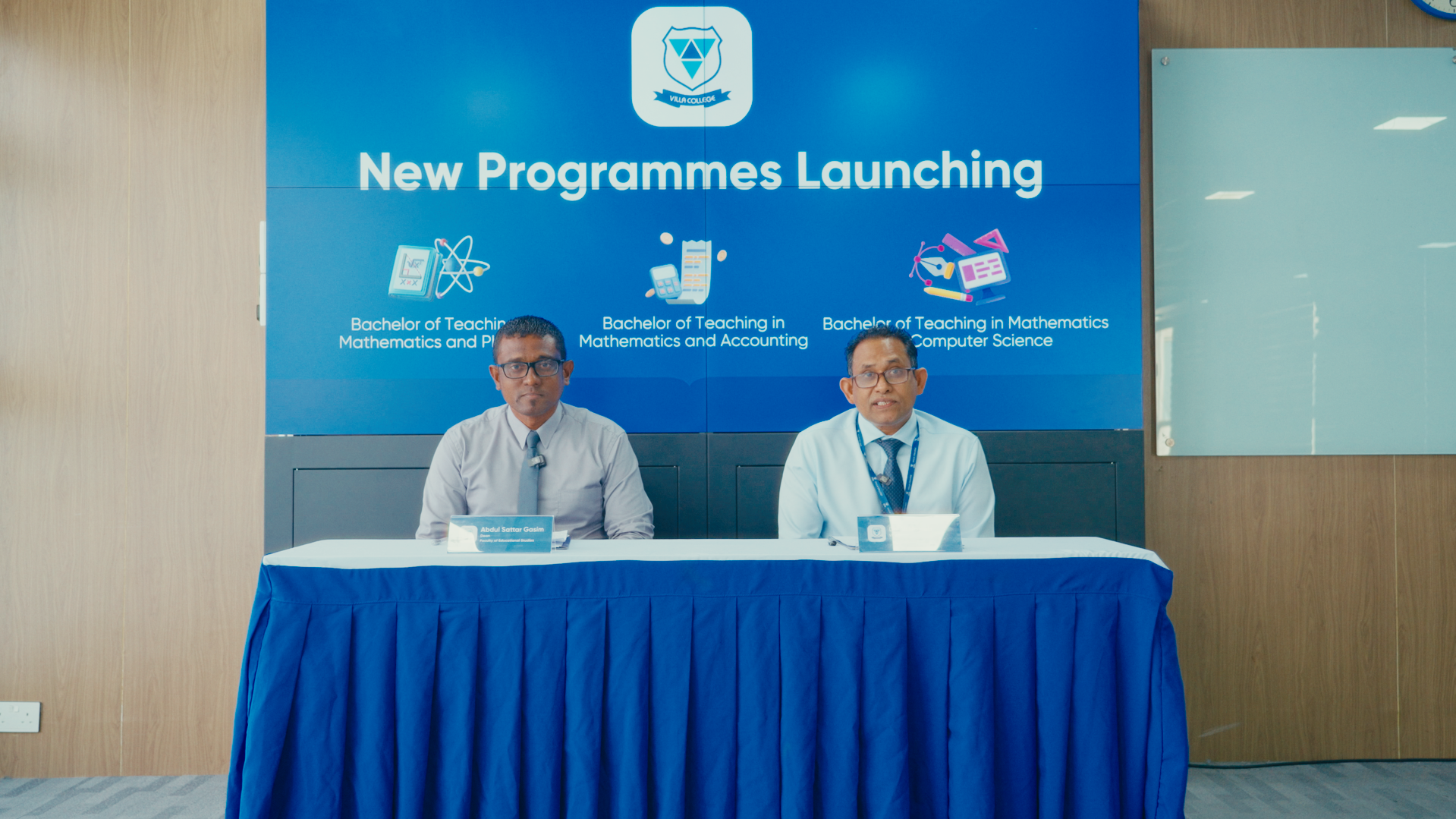
Villa College's Faculty of Educational Studies announced three new Bachelor of Teaching programmes on 21 July 2026, each pairing mathematics with a second teaching subject. They are the Bachelor of Teaching in Mathematics and Accounting, the Bachelor of Teaching in Mathematics and Physics, and the Bachelor of Teaching in Mathematics and Computer Science. All three sit at Level 7 of the Maldives National Qualifications Framework and are open for applications in the September 2026 intake.
The programmes prepare teachers who are specialised in two subjects and qualified to teach at secondary and higher secondary level. Villa College notes that the requirement for subject-specialist teachers able to deliver accounting, physics and computer science alongside mathematics in Maldivian schools is increasing, and the three programmes allow a candidate to qualify in two subject areas within a single degree. Each programme sets out the same broad goals, being to develop teachers who understand the foundations of education and pedagogical knowledge, to develop teachers whose knowledge, skills and values are applicable to the changing context of the Maldives, and to develop graduates able to plan, design, implement and review syllabi, including the development of teaching and learning strategies and curriculum materials.
The shared spine has two components. The first is a six-module mathematics sequence taken by every student regardless of pathway, comprising Calculus and Algebra in the first year, Further Calculus and Statistics and Mechanics in the second, and Further Algebra and Further Statistics and Mechanics in the third. The second is an eleven-module professional core covering Developmental Psychology, Curriculum, Assessment and Innovative Practices, English Language for Teachers, The Psychology and Sociology of Education, Sustainability: Theory, Practice and Impact, Digital Technologies and AI in Teaching and Learning, Inclusivity in Education, the two-part Teaching and Learning Mathematics sequence, and two teaching practicums.
Two of those shared modules are worth noting individually. Digital Technologies and AI in Teaching and Learning, and Sustainability: Theory, Practice and Impact, are each full 15-credit modules taken in the third semester rather than themes distributed across other coursework. In the computer science pathway, artificial intelligence therefore appears twice and in two distinct roles, once as subject content through Artificial Intelligence for Cyber Security and once as a professional tool through the shared teaching module.
The accounting pathway consists of Principles of Accounting and Introduction to Management Accounting in the first year, Financial Reporting and Financial Accounting in the second, and Strategic Corporate Reporting and Advanced Management Accounting in the third. The sequence progresses from introductory bookkeeping principles to corporate reporting at a level well beyond secondary syllabus content.
The physics pathway comprises Introduction to Fundamentals of Physics and Dynamics and Newtonian Laws, followed by Planetary Motion, Optics and Sound and Electricity and Magnetism, and concluding with Particle Physics and Relativity and Thermodynamics, Matter and Astrophysics. The programme states as an outcome that students will demonstrate laboratory skills and understanding of the major laboratory techniques and principles related to physics, which reflects how much of school physics is delivered through demonstration and experiment.
The computer science pathway covers Database Management System and Introduction to Networks in the first year, Artificial Intelligence for Cyber Security and Human Computer Interaction in the second, and Software Engineering Principles and Secure Software Development in the third. The selection leans towards applied and security-conscious computing rather than theory alone.
Each programme includes four dedicated pedagogy modules rather than a single general course in teaching method. Every student takes Teaching and Learning Mathematics 1 in the third semester and Teaching and Learning Mathematics 2 in the fifth, paired with the equivalent two-part sequence in accounting, physics or computer science depending on pathway. The partner-subject pedagogy modules sit in the same semesters, so subject method is taught twice for each of the two subjects, at second-year and third-year level.
The distinction matters because the difficulties learners encounter tend to be specific to the material in front of them, and a subject-specific module can address those difficulties in a way a general one cannot. Splitting each sequence across two years also means method is revisited after classroom experience rather than covered once and set aside.
All three programmes run full-time and face-to-face over three years and six semesters, with every module delivered on campus. Students who complete the fourth semester receive an interim award, which is subject-specific rather than generic: the Advanced Diploma of Teaching in Mathematics and Accounting, in Mathematics and Physics, or in Mathematics and Computer Science. This gives the degree a defined and nameable outcome at the halfway point for anyone whose circumstances change.
School experience is distributed rather than concentrated. Teaching Practicum 1 falls in the fourth semester, immediately before the interim award, and Teaching Practicum 2 in the sixth, so students enter their final year having already taught in a school.
The general criteria offer three routes, being two passes at GCE A-Level or HSC with a grade of E accepted as a pass at A-Level and a grade of C or above at HSC, or a Level 4 qualification in a related field, or a Level 4 Foundation Study Programme approved for the relevant diploma programme.
Two alternative routes sit alongside these. An applicant holding a Level 4 qualification in an unrelated field may enter on successful completion of an MQA-approved University Preparation Programme. Alternatively, an applicant who is at least 20 years old, has completed secondary school and has two years of relevant work experience may enter on the same basis. That second route is the one most likely to interest employers, since it opens the programmes to experienced staff without a conventional academic record.
Speaking on the introduction of the programmes, the Dean of the Faculty of Educational Studies, Abdul Sattar Qasim, described them as an important step towards preparing the subject-specialist teachers that Maldivian schools require. He said that developing capable teachers in mathematics together with accounting, physics and computer science would further strengthen the quality of teaching at secondary and higher secondary level.
Villa College's Vice Rector, Dr Ali Najeeb, described the formation of high-quality teachers specialised across multiple subjects as a matter of national importance, and the three programmes as part of the College's wider work to expand teacher training opportunities. He noted that creating quality opportunities for Maldivian students within the country remains one of the College's objectives.
For schools and education employers, the shared spine has a practical implication worth noting. Because 17 of the 25 modules are common across all three programmes, graduates of the different pathways arrive with the same professional and mathematical grounding and differ only in their second specialisation. Recruitment beyond the next three years can therefore be planned around a consistent baseline. Organisations that support staff development or scholarship schemes have a defined window ahead of the September 2026 intake.
Applications are open for all three programmes. Further information is available at www.villacollege.edu.mv or by telephone on 3303200.