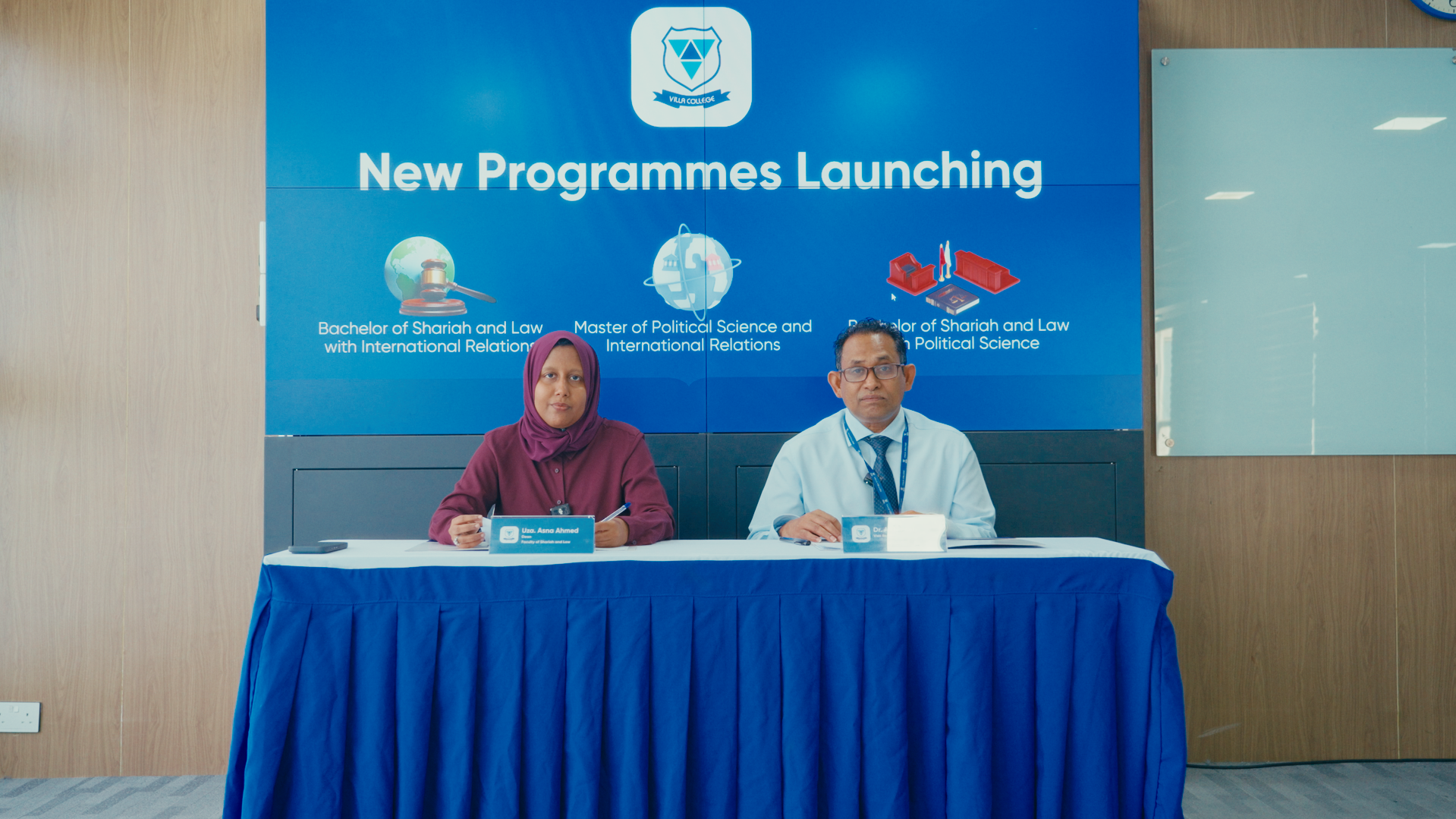
On 21 July 2026, Villa College's Faculty of Sharia and Law launched three new academic offerings designed to integrate legal education with political science and diplomacy. These comprise the Bachelor of Sharia and Law with Political Science, the Bachelor of Sharia and Law with International Relations, and the Master of Political Science and International Relations, with applications open for the September 2026 intake. As the Maldives maintains an active role in regional and international policy, there is a growing institutional and corporate need for professionals equipped with both rigorous legal grounding and broad strategic capabilities. By extending traditional legal training into the adjacent fields of policy and diplomacy, these programmes prepare graduates for complex public, corporate, and international environments.
A key structural challenge in interdisciplinary higher education is maintaining professional accreditation while expanding curriculum breadth. In many traditional educational models, interdisciplinary scope is achieved by substituting elective subjects for core professional modules, which can jeopardize a graduate's eligibility for professional legal licensing. Villa College resolves this issue by embedding interdisciplinary specialisations within a framework that preserves the full academic requirements of a qualifying law degree. Both undergraduate programmes are accredited by the Maldives Qualifications Authority and approved by the Bar Council of the Maldives, ensuring graduates meet national licensing standards. Prospective applicants to the law degrees must also satisfy the English language qualification standards established by the Bar Council.
The undergraduate degree architecture utilizes deferred specialisation to enhance candidate decision-making. Spanning three years across six semesters, delivered via face-to-face instruction or e-learning, both programmes dedicate the first two years to core legal study. Students complete foundational modules required for practice in the Maldives, including Law of Contract, Constitutional Law, Criminal Law, the Maldivian Legal System and Methods, Islamic Family Law, and Islamic Law of Inheritance. Rather than forcing students to choose between law and policy at the point of enrolment with limited domain insight, this structure defers the specialisation choice until the final year while keeping the legal foundation complete. In the third year, Political Science pathway students complete modules such as Comparative Politics and Issues, Religion and Politics, and Development and Public Policy, whereas International Relations pathway students undertake modules such as Counterterrorism and National Security, Maldivian Foreign Policy, and Foreign Policy of Major Powers.
To complement academic coursework, the faculty embeds practical, industry-relevant exposure directly into its educational model. Experiential learning serves as a distinguishing element of the provision, highlighted by the Street Law initiative, an educational method introduced to Maldivian legal training that currently operates as a co-curricular activity with planned integration into the formal curriculum. Students also participate in mooting, pro bono activities, and the Law Student Society. Furthermore, the curriculum incorporates practical legal subjects such as Employment Law, Alternative Dispute Resolution, and Force and Fear, Crime and Punishment, giving students exposure to diverse legal sectors before entering the professional workforce.
At the postgraduate level, the Master of Political Science and International Relations addresses the demand for advanced analytical capacity in public and international affairs. Delivered over three semesters through e-learning or face-to-face teaching, the master's curriculum covers Global Governance and International Organisation, Diplomacy and International Negotiations, Geopolitics and South Asia, and Security Studies. A central component of the programme is an independent dissertation. Unlike taught modules that evaluate familiarity with established concepts, the dissertation requires candidates to independently define a research question and defend their findings. This analytical capability is directly applicable to senior roles across foreign affairs, diplomacy, non-governmental organisations, policy consulting, public administration, research journalism, and academia.
The strategic direction of these programmes aligns with Villa College's vision of developing highly capable professionals for national and international service. At the launch, Uz. Asna Ahmed, Dean of the Faculty of Sharia and Law, noted that the programmes establish a firm legal foundation while opening broad opportunities in policy and diplomacy, which are essential sectors for an internationally engaged nation such as the Maldives. Villa College Vice Rector Dr Ali Najeeb highlighted that these offerings exemplify the institution's commitment to educating professionals capable of evaluating complex issues from a broad perspective, thereby expanding career opportunities and addressing key national manpower needs.
For prospective students and organisations evaluating professional development options, several entry pathways are available. Standard undergraduate entry requires passes in two subjects at GCE A Level or HSC, a Level 4 qualification in a related field, or completion of a Level 4 foundation studies programme for the diploma pathway. Standard master's entry requires a bachelor's degree in a related field or a Level 8 graduate diploma. Alternative entry pathways are also accessible for non-traditional candidates. Undergraduate alternative entry requires either an unrelated Level 4 qualification combined with an MQA-approved University Preparation Programme, or an age threshold of twenty years, secondary school completion, two years of relevant work experience, and completion of the preparation programme. Postgraduate alternative entry requires candidates to be at least twenty-five years old, complete an MQA-approved Pre-Master's Programme, and hold either a related Level 5 qualification with seven years of relevant experience, including three and a half years post-qualification, or a related Level 6 qualification with six years of experience, including three years post-qualification. Applications for all three programmes remain open for the September 2026 intake, with details available at www.villacollege.edu.mv or by contacting 3303200.